The roots of this Black Miami Studies Initiative (BMSI) are a decade long, seeded as I re-encountered Miami as a Black faculty member at the University of Miami. Academically, it has been grappling with unsatisfying, erroneous, and often incomplete representations of Black Miami in much of the extant scholarship and public discourse. It was also finding pure intellectual joy when the fullness of Black Miami showed up in scholarship like Nathan Connolly’s groundbreaking book, A World More Concrete: Real Estate and the Remaking of Jim Crow South Florida (2014), Marvin Dunn’s Black Miami in the Twentieth-Century (1997), Chanelle Rose’s The Struggle for Black Freedom in Miami (2015), Tatiana McInnis, To Tell a Black Story of Miami (2022), and more recently Sharony Green’s Voices from a Black Miami Neighborhood (2025) (see citations page).
While I have lived in various parts of the city, from the “upper west side” to West Miami, increasingly, the Miami of my everyday habitude centers in and around Coral Gables. As a middle-class Black woman raised in Brooklyn, living in this neighborhood correspondingly has meant quotidian encounters with navigating anti-black racism and feelings of estrangement in a multicultural city. As a humanities scholar trained at the intersections of American Studies, Black Studies and Caribbean Studies, Miami presented a vexing case study about the local operations of race and ethnicity, inclusion and exclusion. I set myself the task of seeking nuanced answers to this question through careful scholarship and coursework informed by everyday encounters throughout the county. My first concerted attempts at an answer came through the Black Cities lecture series that sought to better understand Miami by placing it in juxtapositional relationship to other US and regional hemispheric cities like Oakland, California, Camden, NJ, New York City, and Cartegena, Colombia. Through these scholars we learned the global contours of gentrification that restricted Black lives as well as the spaces where blackness and brownness were more readily able to see their linked fates.
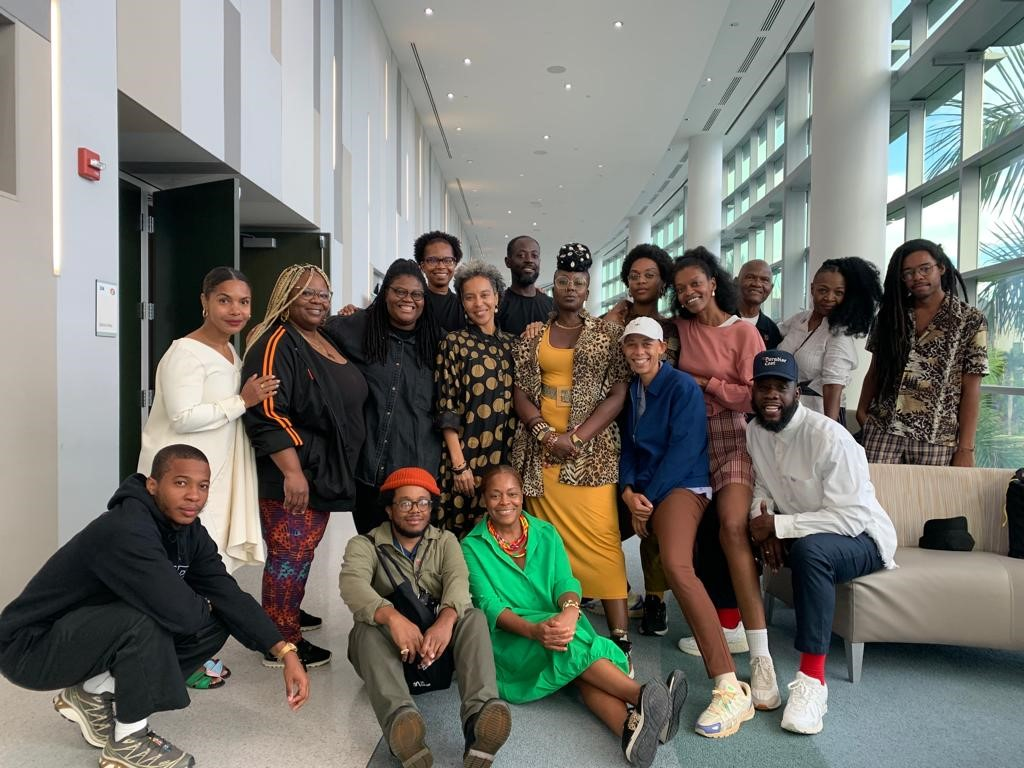
The ongoing quest to understand Miami’s relation to Blackness more deeply inspired my first convening that gathered a constellation of Black academics who answered the prompt to share how this city shaped their intellectual and artistic formations. That April 18, 2018 gathering sought to test my reading of Miami alongside and against academics who were born and raised in this city. Their stories underscored that the Miami my academic peers inhabited in the past, was not my current Miami. In fact, while we know there is no singular Black Miami, their critical reflections underscore just how much historical moments and neighborhoods matter. Those scholars born before 1980 and raised on the cusp of the enactments of Civil Rights legislations navigated a Miami in which Jim Crow systems of Black businesses were able to buttress them as they tried to take advantage of what Civil Rights gains might offer. The Miami of the post 2010s finds us grappling with the increasing loss of historic Black neighborhoods and institutions to divestment and gentrification. We were already feeling lost in the fog of the whitewashing Black History in classrooms and DEI rollbacks; but post May 2026, we also now live in the wake of the Supreme Court's gutting of the Voting Rights Act.
Mapping Creole Miami
After a decade of study, which includes listening both quietly and deeply, I have heard resonances, internal tensions, and linked fates. This Black Miami Studies Initiative reflects my academic commitment to creating generative spaces to explore the complexities of Black life and thought in Miami Dade County. My scholarship has been committed to a careful contextualization of the long arc of the occluded, but integral, Black presence in Miami as a reparative act of social justice. Through intellectual gatherings at the University of Miami, I have sought to accelerate and carefully situate scholarship on Black Miami Studies. Working to create a collective ethos, these gatherings have tried to make intellectual intimates of the various participants where there is also a commitment to publish to build scholarship in this subject area: in the fields of history, cultural studies, anthropology, performance studies and Black Studies. I have insisted on a few standard practices: one, that recuperative histories and memory work about Miami be convened in the city itself with Black Miamians as both key participants and audience members; two, that artists/participants write narratives for published proceedings; three, that we build a pipeline of intellectuals producing Black Miami Studies scholarship.
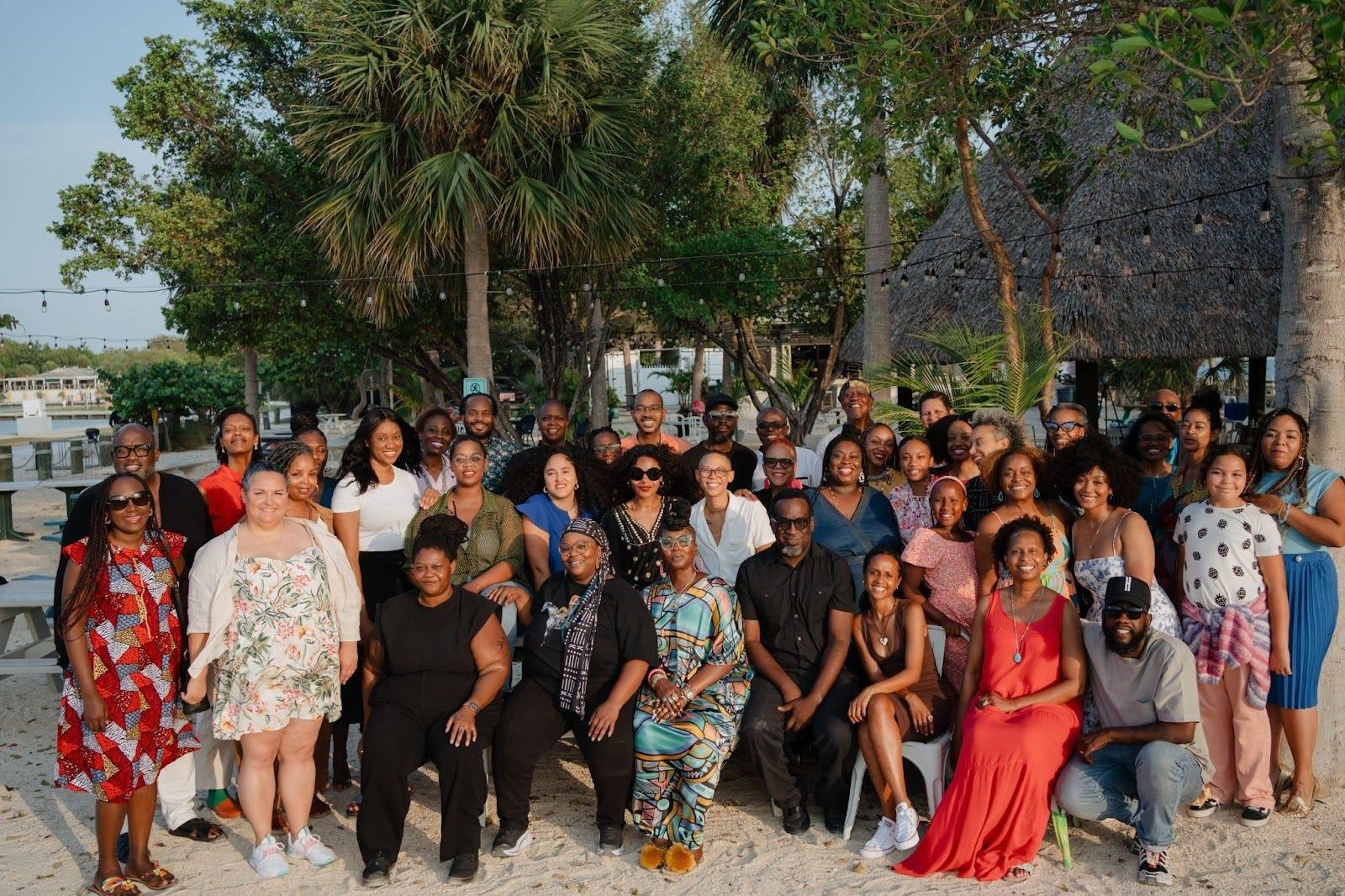
Over the years, at different scales and for different, but intersecting audiences, I have convened intellectual gatherings around the themes of Black Miami intellectuals, Black Miami cinema, Black labor and leisure on segregated beach spaces, and Black Miami urban coastal transformations. These convenings have inaugurated a process of thinking through and thinking with Black Miami. My intellectual practice has been influenced by the Jamaican-British cultural critic Stuart Hall, who understood culture as a "critical site of social action and intervention, where power relations are both established and potentially unsettled.” Therefore, conceptualizing and organizing these convenings and their subsequent publications, have been one way of unsettling dominant power relations about who theorizes Black Miami and thereby who circulates prevailing discursive framings.
What then has it meant to mobilize Black Miami for reconsidering the demands of contemporary criticism as well as the ethical commitments of the university-based critic? Situated on the University of Miami’s campuses, the convenings have been open to the public and organized across sectors to include local educators, cultural producers, museum and cultural industry professionals, and artists alongside academics. To convene at UM is to lean into, while also working against, my institution’s history of Jim Crow segregation that only started admitting Black students in 1961, seven years after the United States Supreme Court’s 1954 ruling in Brown v. Board of Education to desegregate public schools “with deliberate speed.” All UM campuses are surrounded by once historic Black neighborhoods: the main Coral Gables campus sits adjacent to South Miami; the Medical Campus is surrounded by the historic Black neighborhood of Overtown; the Marine Sciences campus on Biscayne Bay sits opposite of the historic Virginia Key Beach, carved out beach space for Black leisure where Blacks were otherwise restricted to segregation and the regulations of sundown towns.
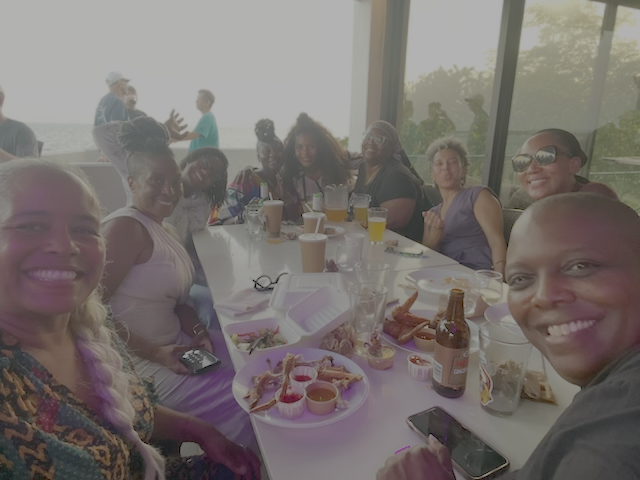
Practices of educational and residential segregation have and continue to mean that Black community members have a fraught history with the University of Miami. It requires therefore, that I, as the Director for the Center for Global Black Studies, make a concerted effort to ensure that the campus is a hospitable space for them. Growing up in working-class Black spaces, many Black Miamians have not had the opportunity to move through more recent and emerging elite Black spaces of sociality. Therefore, one function of the convenings has been to introduce and make these groups aware of, and accessible to, each other. After one convening held on the university’s Marine Science campus, a group of folks stayed on the UM’s side of the historic Virginia Key Beach beach enjoying a scene of conviviality after a long day of conferencing. Philanthropist and Director of The Carter Project Foundation, Tracy Robertson Carter, texted me this picture with the note: “And Still Here! This is giving me and everyone Black joy in abundance!”
Convenings therefore have effectively served as pop-ups that make space for the public exchange of Black intellectual thought in Miami that foreground the value added by local community members, their lived experiences, and expertise. The ethical commitment has been to theorize with, rather than, for Black Miami.
TAKE-AWAYS
These conversations and convenings have revealed lessons about doing multi-sector collaboration and navigating intra-racial tensions that sometimes show up around ethnicity or class, as well as negotiating questions of power. It is not accidental that these attempts to mobilize such a diverse constituency have exposed sites of struggle since various stakeholders wrestle not only with representation, but also with access. Because I work in a leadership role at the University of Miami, there is the perceived and real understanding of my connection to institutional resources. As a result, while I cannot choose everyone, who gets selected versus those who are not can create circumstances where others feel outside of this emerging constellation. Thus, the nascent formation of what I want to think of as a Black Miami Studies constellation is not a felicitous romance of Black folks in Miami coming together across our various institutional sectors and differences. But rather, because this collective is being built from the ground up, there are the inevitable contestations and tensions over what this looks like and indicative of the different stages of group development.
Such dynamics mean that we must attend to not only the structural pressures of anti-Black racism, but also the internal struggles between the various ways Black folks are positioned in Miami. Reluctantly, I have come to abandon cohesion as a desired goal, recognizing that our different grammars and dispositions of Blackness might make this impossible. I also understand disagreements as endemic to any group dynamics, and especially of an emerging collective and intellectual tradition. I try to work against hierarchies even while acknowledging my institutional positionality.
We have, nonetheless, achieved concrete things like a pipeline of students from Black Miami going off to graduate school; graduate students entering the professoriate; and a pipeline of junior faculty from Black Miami writing books about their hometown as critical citation. These works, publications and an emerging network of scholars, form a constellation of intellectuals who begin to recognize each other as writing on this subject area.
Creating these constellations are why I continue to convene the Black Miami Studies Initiative as a model and method for generative Black intellectual thought.